Cryptocurrency Fundamentals
What Are Cryptocurrencies?
Cryptocurrencies are digital or virtual currencies that use cryptography for security and operate on decentralized blockchain networks, enabling peer-to-peer transactions without intermediaries like banks. They represent a shift toward user-controlled, borderless digital money, with Bitcoin as the pioneer.
Cryptocurrencies are digital assets designed to work as a medium of exchange, secured by cryptographic techniques that make them difficult to counterfeit or double-spend. They run on blockchain technology, a distributed ledger that records all transactions transparently and immutably across a network of computers. Unlike traditional money issued by governments, cryptocurrencies are typically decentralized, meaning no single entity controls them. Bitcoin, launched in 2009, was the first and remains the most recognized, often called "digital gold" for its scarcity and store-of-value role.

Abstract representation of cryptocurrencies on blockchain networks.
How Do Crypto Wallets Work?
Crypto wallets are tools (software or hardware) that store the private keys needed to access and manage your cryptocurrencies on the blockchain—they don't actually hold the coins themselves. Wallets range from convenient "hot" options (online, like mobile apps) to more secure "cold" ones (offline, like hardware devices), balancing ease of use with protection against hacks.
A crypto wallet manages access to your funds by storing private keys—the secret codes that prove ownership and authorize transactions. The wallet interacts with the blockchain to send/receive crypto, but the actual assets live on the chain.
- Hot wallets are connected to the internet (e.g., mobile apps like Coinbase or MetaMask), making them convenient for frequent trading but more vulnerable to hacks.
- Cold wallets are offline (e.g., hardware like Ledger or Trezor, or paper wallets), offering superior security for long-term storage.
Wallets can be custodial (a third party holds your keys, like on exchanges) or non-custodial (you control the keys, emphasizing the principle "not your keys, not your crypto").
Crypto wallets are essential interfaces for interacting with these assets. Rather than storing coins, they hold cryptographic keys: public keys (like account numbers for receiving funds) and private keys (like passwords for signing transactions). When you "send" crypto, your wallet creates a transaction signed with your private key, which the network validates and adds to the blockchain.
Wallets vary widely in design and security:
- Hot wallets (online) prioritize convenience—examples include software wallets (desktop/mobile) and exchange-hosted options. They enable quick trades but are exposed to online threats.
- Cold wallets (offline) emphasize security—hardware wallets keep keys isolated from the internet, while paper wallets print keys for physical storage. Best practice is to use cold storage for significant holdings and hot wallets for daily use.
The ecosystem also distinguishes custodial (e.g., exchange accounts where the provider manages keys) from non-custodial (full user control), with the latter aligning more closely with crypto's ethos of self-sovereignty.

Overview of wallet types: software, hardware, paper, etc.
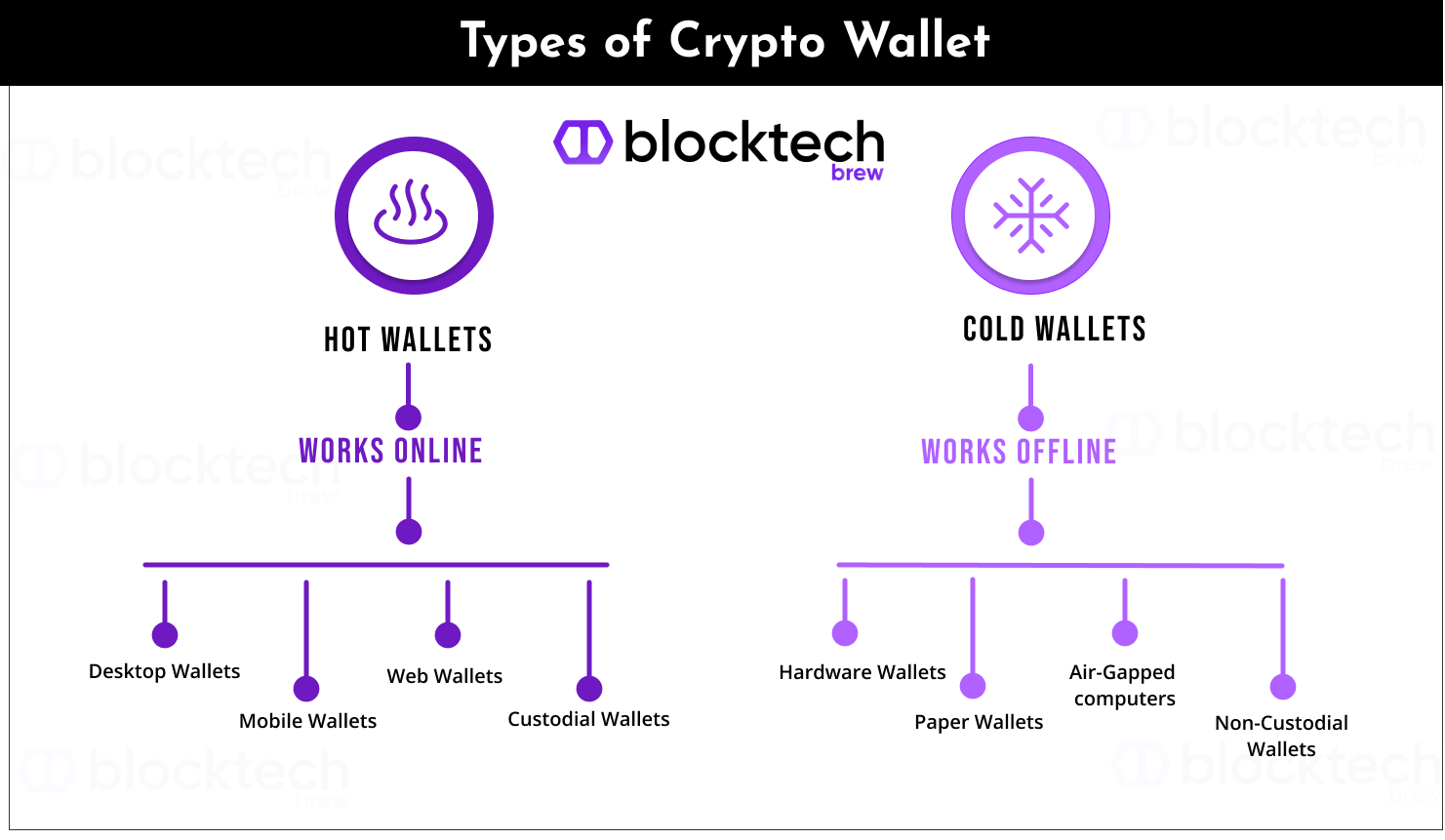
Hot (online) vs Cold (offline) wallets classification.
Popular Cryptocurrencies Today (February 3, 2026)
Popular cryptocurrencies in February 2026, based on market capitalization, include Bitcoin (BTC) as the dominant store of value, Ethereum (ETH) for smart contracts and decentralized apps, stablecoins like Tether (USDT) and USDC for price stability, and others like BNB, XRP, and Solana for specific use cases such as payments and high-speed transactions.
The crypto market is dynamic, with rankings shifting based on adoption, technology, and sentiment. As of early February 2026, the total market cap hovers around $2.64 trillion. Here's a snapshot of leading ones by market cap (data from CoinMarketCap):
- Bitcoin (BTC): The original cryptocurrency, focused on secure, decentralized value transfer. Price: ~$78,733 | Market Cap: ~$1.57T | Store of value, digital gold; original and most secure network.
- Ethereum (ETH): Powers smart contracts, DeFi, and NFTs. Price: ~$2,315 | Market Cap: ~$279B | Smart contracts, DeFi, NFTs; transitioning to more efficient proof-of-stake.
- Tether (USDT): Stablecoin pegged to the USD for low-volatility transactions. Price: ~$0.999 | Market Cap: ~$185B | Stablecoin pegged to USD; widely used for trading pairs.
- BNB (BNB): Exchange utility. Price: ~$779 | Market Cap: ~$106B | Utility token for Binance ecosystem; powers fees and DeFi.
- XRP (XRP): Cross-border payments. Price: ~$1.61 | Market Cap: ~$98B | Fast cross-border payments; associated with Ripple network.
- USDC (USDC): Stablecoin pegged to the USD. Price: ~$1.00 | Market Cap: ~$71B | Regulated stablecoin; transparent reserves.
- Solana (SOL): High-speed/low-cost. Price: ~$104 | Market Cap: ~$59B | High-throughput blockchain; popular for speed and low fees.
- TRON (TRX): Price: ~$0.28 | Market Cap: ~$27B | Content/entertainment focus; high transaction volume.
- Dogecoin (DOGE): Price: ~$0.11 | Market Cap: ~$18B | Meme coin with strong community; occasional payment use.
- Hyperliquid (HYPE): Price: ~$37 | Market Cap: ~$11B | Emerging project with rapid growth; specifics vary.
Others like BNB (exchange utility), XRP (cross-border payments), Solana (high-speed/low-cost), and meme coins like Dogecoin. This ranking can shift quickly due to market dynamics, technological upgrades, or regulatory news.
Bitcoin and Ethereum remain foundational, while stablecoins facilitate everyday utility and altcoins like Solana drive innovation in scalability.
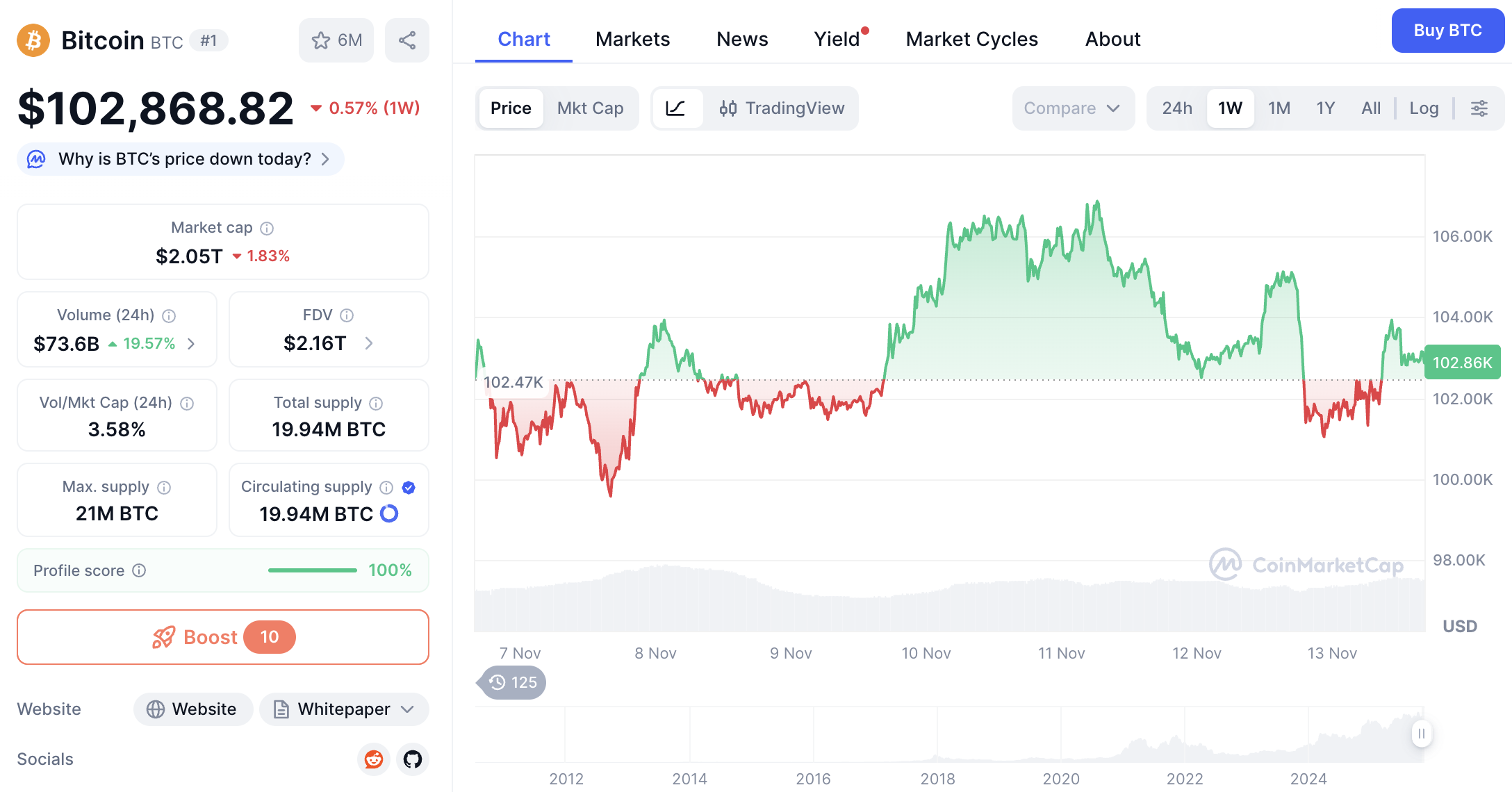
Example of cryptocurrency price and market cap chart (Bitcoin focus).
In-Depth Overview of Cryptocurrency Fundamentals
Cryptocurrencies represent one of the most transformative developments in digital finance since the internet's rise. At their core, they are decentralized digital assets that leverage blockchain technology—a tamper-resistant, distributed ledger—to enable secure, transparent peer-to-peer transfers without relying on traditional financial intermediaries. This decentralization stems from the 2008 Bitcoin whitepaper by Satoshi Nakamoto, which introduced a system for electronic cash that solves the double-spending problem through proof-of-work consensus. Since then, thousands of cryptocurrencies have emerged, each with unique features, from smart contract platforms to stable value anchors.
The fundamental appeal lies in key properties: scarcity (e.g., Bitcoin's 21 million cap), pseudonymity, global accessibility, and resistance to censorship. However, they carry risks like extreme volatility, regulatory uncertainty, and security threats. Adoption has grown significantly, with institutional involvement and real-world use cases in payments, remittances, and decentralized finance (DeFi) driving momentum into 2026.
While cryptocurrencies offer exciting potential for financial inclusion and innovation, they also face challenges like energy use (though improving with proof-of-stake), scams, and volatility. Always research thoroughly and consider only what you can afford to lose.
Complete this lesson
Mark as complete to track your progress